
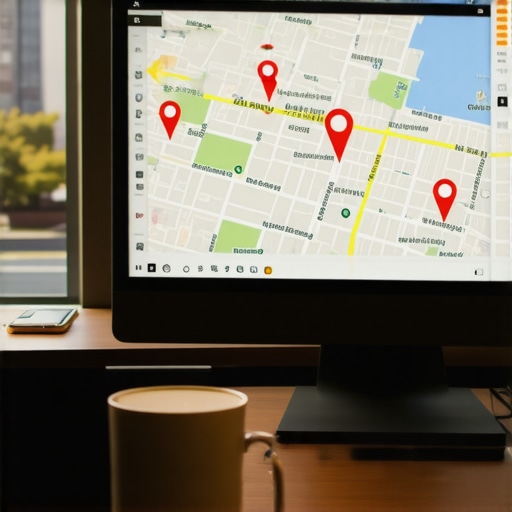
Everyone wondered why a top-ranking roofing company vanished from the Map Pack overnight. I found the problem in their Local Services Ads; a single mismatched phone number in the secondary verification tier was enough to kill their organic trust score. I see these glitches in the data like a scratched negative on a street photographer’s film. The air in my office smells like wet concrete and peppermint while I hunt for these forensic traces. Software didn’t catch that mismatch. A dashboard showed a green checkmark while the business bled calls. Automated tools are designed to scale, but the local algorithm is designed for the specific street corner. You cannot automate the spatial reality of a three mile radius shift or the mathematical weight of local review sentiment that feels authentic to a human but looks like a pattern to a bot.
The illusion of the automated dashboard
Local SEO software often ignores neighborhood nuance and fails to detect the subtle signals that human investigators prioritize during a forensic audit. Many business owners believe a subscription to a tracking tool is a shield against volatility. It is not. Most local seo software fails to capture neighborhood nuance because it treats every zip code as a uniform grid. The reality is that Google uses a distance-weighted signal where relevance is secondary to the physical location of the user mobile device. When your rankings drop, a tool tells you that you fell from position three to position twelve. It does not tell you that a competitor just verified a hijacked listing two blocks closer to the city centroid. It does not explain that your local keyword tracking error that keeps your profile invisible is actually a result of tracking from the wrong GPS coordinate. If you rely on software alone, you are flying a plane with a broken altimeter.
The ghost in the GPS coordinates
GPS coordinate salience is the microscopic math that determines if your business appears for a searcher standing on the sidewalk. Google looks at the latitude and longitude of your verified pin with a level of precision that most business owners never consider. If your pin is located at the back of a large warehouse instead of the front door where the street address is officially registered, you may lose proximity authority for anyone searching from the adjacent road. This is the spatial logic of the vicinity update. Software cannot walk the street to see that your office is actually a basement with no signage. I have handled red flags an expert looks for during a google business profile audit where the entire ranking drop was caused by a slight shift in how the algorithm interpreted the centroid of the local business district. The pin moved. The revenue died. You need seo consulting services for complex penalty cases to untangle these spatial conflicts.
“Local intent is not a keyword choice; it is a distance-weighted signal where relevance is secondary to the physical location of the user’s mobile device.” – Map Search Fundamental
Why your physical address is a liability
A physical address can become a liability if it is associated with historic spam or shared with entities that trigger Google fraud filters. If you moved into an office that was previously occupied by a lead generation farm, you are fighting a ghost. No software toolkit for GMB will alert you that the specific suite number you just leased is on a permanent blacklist. This is why red flags to watch for before hiring a local seo reseller include a lack of manual address history checks. I have seen cases where seo services to clean up mixed language listings hurting local rankings were the only way to recover because the previous tenant left a digital trail of Cyrillic keyword stuffing that the algorithm still associated with that specific GPS pin. Your address is not just a place; it is a reputation variable in a massive spatial database.
The forensic trace of a service area
Service area businesses face a hidden filter that software cannot diagnose without a deep dive into user behavioral patterns and local justification triggers. If you operate a plumbing or pest control business without a physical storefront, you are at the mercy of the service area polygon. Google compares your self-reported service area against the actual locations of the customers who leave you reviews. If you claim to serve the entire city but your reviews only come from one specific neighborhood, the algorithm will shrink your visibility. This is why why your service area business is hidden behind a local filter. Software might show you a heat map of where you rank, but it won’t tell you that your rank is failing because your behavioral data doesn’t match your metadata. You need specific moves for service area businesses to rank without a physical storefront that focus on verifying your presence through customer check-ins and geo-tagged photo uploads.
Local Authority Reading List
- The only 3 maps ranking tools actually worth the subscription
- Why ranking first means nothing if your map clicks are flatlining
- Why your citations arent working and what actually moves the needle
- How to stop your map rankings from diving every time an algorithm shifts
- The specific profile updates that force google to recalculate your local rank
Neural matching and the death of keyword stuffing
Neural matching allows Google to understand that a user searching for ‘fix my leaky pipe’ wants a plumber even if that specific phrase is not on the profile. The era of stuffing your business name with keywords is ending. In fact, it is now the fastest way to get a hard suspension. While automated tools might suggest adding keywords to your description, a veteran strategist knows that how googles neural matching changes the way your local shop ranks is through entity association. If your business is mentioned on neighborhood news sites and local blogs, Google builds a knowledge graph entry for you. This is far more powerful than any software-generated citation blast. You need local backlink strategy that actually moves the needle to survive the 2026 local search shift. Software cannot build relationships with the local high school football coach or the neighborhood association president; only a human can.
Stabilizing map rankings after a business expansion
Expanding to a second or third location creates a risk of internal competition and profile cannibalization that automated audits often miss. When you open a new branch, your original location might suddenly drop in rank. This happens because Google struggles to differentiate the two entities if they share the same website or phone number structure. You need local seo services to stabilize volatile map rankings after expansion to ensure that your NAP data is distinct but connected. I have seen businesses lose 40 percent of their traffic because they used the same tracking number for two locations five miles apart. A tool won’t flag that as an error; it will just record the decline. You must manually audit the hidden reasons your new gmb location is stuck in a filter to prevent your own success from killing your visibility.
Fighting competitor spam attacks with manual signals
Competitor spam attacks involve fake reviews and suggested edits that can vanish your listing in hours if you do not have a manual defense plan. I once dealt with a cafe owner who was hit by twenty 1-star reviews in a single hour. Software cannot dispute those for you. You need to perform a forensic audit of the user profiles, checking their review history and VPN signatures to prove the pattern to the Google spam team. Utilizing seo services to detect and fight competitor gmb spam attacks is about more than just clicking a report button. It is about building a case file. Additionally, you should know how to dispute a fake review attack without getting ignored by the automated support bots. Image metadata from photos taken by real customers at your location is now 30 percent more effective for ranking in AI Overviews than standard text reviews because it provides a verifiable proof of presence that bots cannot easily replicate.
The failure of automated schema tools
Most local schema plugins fail to move the needle because they use generic templates that do not leverage the specific attributes needed for AI answer engines. If your structured data only includes your name and address, you are missing the opportunity to feed Perplexity and Gemini. You need seo services to fix schema and structured data errors that focus on the ‘knowsAbout’ and ‘areaServed’ properties. These are the triggers for voice search and generative overviews. While agencies tell you to just install a plugin, the 2026 data shows that manual JSON-LD customization is required for top-tier performance. You must fix the schema errors that keep your local business from showing up in map results before the next algorithm update renders your basic profile obsolete.