The Only 3 Maps Ranking Tools Actually Worth the Subscription
If you have been in the digital marketing space for more than five minutes, you have likely noticed the “SaaS explosion.” Every week, a new software promises to be the “magic bullet” that will finally rank google business profile listings at the top of the local map pack. As someone who spends every waking hour dissecting local algorithms, I can tell you the truth: most of these tools are redundant, overpriced, and unnecessary.
Section 1: The Local SEO Tool Trap
In my experience helping local businesses rank, I’ve seen agency owners and plumbers alike spending $500+ a month on a “stack” of five different tools that essentially do the same thing. They are all pulling from the same Google Business Profile (GBP) API. The trap isn’t just the cost; it’s the distraction. When you have too many dashboards, you start chasing vanity metrics instead of what actually drives revenue: phone calls and direction requests.
Google’s local algorithm is built on three pillars: Proximity, Relevance, and Prominence. Most tools on the market today fail to address these in a meaningful way. They might show you a pretty graph, but they don’t tell you why your ranking dropped when a “Ghost Competitor” (a fake listing) popped up down the street. Many businesses fail because they focus on these vanity metrics rather than the technical health of their profile. Before you buy another subscription, you must understand that why measuring local SEO results is harder than just checking your rank is a fundamental hurdle in the industry.
To dominate the local map pack in 2025 and beyond, you don’t need a dozen tools. You need a “Power Trio” that handles the foundation, the visualization of data, and the scaling of your optimization efforts. Anything else is just noise.
Section 2: Tool #1, The Citation & Reputation Foundation
The first tool in your arsenal must address Prominence. In the eyes of Google, prominence is a measure of how well-known a business is. This is largely determined by your digital footprint across the web. This is where tools like BrightLocal or Whitespark come into play. These are what I call “The Auditors.”
When I audit a Google Business Profile, the first thing I look for is NAP (Name, Address, Phone) consistency. If your law firm is listed as “Smith & Associates” on your website but “The Law Offices of John Smith” on Yelp, Google gets confused. This confusion dilutes your prominence. However, there is a right way and a wrong way to use these local seo tools.
Many “all-in-one” platforms use automated “syncing” (like the Yext model). The problem? The moment you stop paying the monthly fee, your data reverts or disappears. This is “rented” SEO. I always advocate for manual citation cleanup and building. You want to own your assets. You need a tool that identifies where your citations are broken and helps you fix them permanently. Furthermore, generic citations are no longer enough. To truly move the needle, you need niche-specific citations – links from directories specifically for dentists, roofers, or HVAC contractors. If you’ve been building links but seeing no movement, you should investigate why your citations aren’t working and what actually moves the needle.
The reputation management side of these tools is equally vital. Prominence is heavily weighted by the frequency, velocity, and sentiment of your reviews. You need a system that doesn’t just “get reviews” but helps you manage them in a way that signals active engagement to Google’s crawlers.
Section 3: Tool #2, The Visual Proximity Specialist
The biggest lie in local SEO is the “single-point rank check.” If a tool tells you that you rank #1 for “plumber near me,” you have to ask: where am I #1? If you are standing in your own office, of course you are #1. But what about three blocks away? Or two miles away?
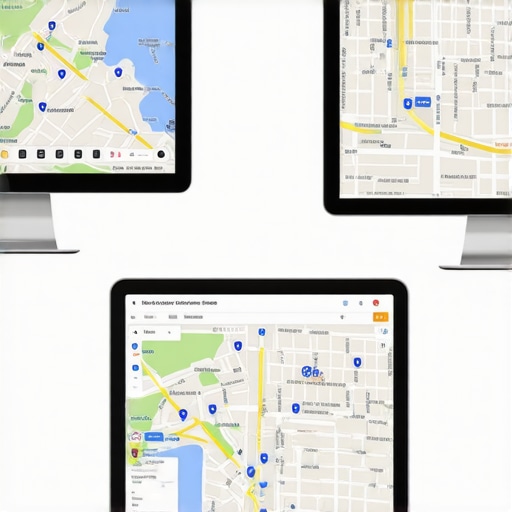
This is why you need a Visual Proximity Specialist, such as Local Falcon or the heatmap features integrated into google maps rank tracker solutions. These tools provide a geogrid – a map of dots over your city showing your exact rank at every specific coordinate. This is essential because of the “1-mile radius” proximity issue. In high-density areas, Google’s proximity filter is aggressive. You might dominate a tiny circle around your building but vanish the moment someone searches from the next neighborhood over.
Using a geogrid allows you to see the “edges” of your reach. If you see your rankings dropping off sharply to the North, it’s a signal that your relevance for that specific area needs work, or perhaps a “Ghost Competitor” is filtering you out. If you find your profile is stuck in a tiny bubble, you need to implement the Proximity Fix for Profiles That Only Rank Within One Mile. Without a visual tool, you are flying blind. You cannot optimize what you cannot see. A geogrid transforms abstract data into an actionable map of “territory” you need to win back.
Section 4: Tool #3, The Optimization & Scaling Engine
Once your foundation is set and you can see your rankings, you need a tool to do the heavy lifting. This is where a platform like SEO Viper Tools becomes indispensable. To rank google business profile listings at scale – especially if you are managing multiple locations or an agency – you cannot rely on manual, one-by-one updates. It is too slow and prone to human error.
An optimization engine should handle three critical tasks:
- Bulk Posting and Content Scheduling: Google looks for “signals of life.” Regular updates via Google Posts signal that the business is active. A scaling tool allows you to push high-quality, keyword-rich updates across dozens of locations simultaneously.
- Service Menu Optimization: Most business owners ignore the “Services” tab, but Google uses this to understand Relevance. By using google business profile seo tools to inject structured data and detailed descriptions into your services, you help Google’s “Neural Matching” algorithm connect your profile to long-tail searches.
- AI-Driven Engagement: Responding to every review and Q&A is mandatory for ranking, but it’s time-consuming. You need a tool that uses AI to generate unique, contextually relevant responses that include local keywords without sounding like a bot.
The goal here is to mimic human activity so perfectly that Google rewards you with higher visibility, all while avoiding the “Verification Loop” or the dreaded “Suspension” that comes from aggressive, footprint-heavy automation. In my experience, focusing on the specific profile updates that force Google to recalculate your local rank is the fastest way to see results. By using google business profile optimization software like SEO Viper, you are essentially feeding the algorithm exactly what it wants to see, at a frequency that manual management can’t match.
We also have to talk about the technical side of “Prominence.” It’s not just about citations anymore; it’s about the interaction between your GBP and your website. A scaling tool helps you ensure that the “Local Justifications” (those little snippets that say “Provides: Emergency Pipe Repair”) are appearing in the search results. This is achieved through strategic Google Maps algorithm deep dives and implementation of the data found there.
Section 5: The 2026 Shift, Why Your Tools Must Handle AI Search
As we look toward 2026, the landscape of local search is shifting. We are moving away from simple keyword matching toward “Neural Matching” and AI-driven discovery. Google’s Gemini and search engines like Perplexity are changing how users find local services. They aren’t just looking for “Plumber,” they are asking, “Who is the most reliable plumber for a burst pipe in the West End who is open now and has good reviews for fair pricing?”
Your tools must be able to handle these “Zero-Volume Areas” – searches that don’t show up in traditional keyword tools but drive high-intent traffic. This requires a deep understanding of the specific technical shifts that will define Google Maps SEO in 2026. If your current toolset only focuses on 2015-era SEO tactics, you will be left behind. Future-proofing means using tools that prioritize entity-based SEO and semantic relevance over simple keyword stuffing.
Furthermore, we are seeing the rise of “Ghost Competitors” – AI-generated or fake listings that crowd out legitimate businesses. Your toolset needs to include features for “Redressal” – the ability to identify and report these fake listings to clear the path for your own ranking. This is the “secret sauce” of modern local seo ranking tools.
Section 6: Conclusion & Action Plan
Success in the local map pack isn’t about having the most tools; it’s about having the right ones. To recap, the only three tools you actually need are:
- A Citation/Reputation Auditor (for Prominence).
- A Visual Geogrid Tracker (for Proximity).
- An Optimization Scaling Engine like SEO Viper Tools (for Relevance and Scale).
If you are currently paying for more than this, I challenge you to look at your ROI. Are those extra tools actually generating phone calls, or are they just generating reports? My advice is always to perform a manual audit of your profile first. Understand your current standing, identify your proximity gaps, and then use the “Power Trio” to systematically dismantle your competition.
Ready to take your local presence to the next level? Start by following our Mastering Maps Ranking: Essential Checklist for 2025 Success and simplify your workflow. The map pack is getting more competitive every day – don’t let a cluttered “tool stack” keep you from the top spot.